A team led by Prof. Ping Zheng at the Kunming Institute of Zoology, Chinese Academy of Sciences, and Prof. Songmin Ying at Zhejiang University School of Medicine has constructed the first high-resolution map of early replication fragile sites (ERFSs) in human embryonic stem cells (hESCs). Published in Stem Cell Reportson June 18, 2026, the study addresses why copy number variations (CNVs) and single nucleotide variants (SNVs) recurrently accumulate at specific genomic regions during prolonged hESC culture—a key concern for regenerative medicine.
Overcoming hESC sensitivity to conventional synchronization agents, the team developed a two-step cell cycle synchronization strategy combining low-dose drug treatment with hydroxyurea-induced replication stress. Using EdU labeling and CUT&Tag profiling of replication stress-associated proteins (RPA, BRCA1, SMC5) and the DNA damage marker γH2AX, they identified 2,404 high-confidence ERFSs in H9 cells and 1,438 in TJ-1# cells.
ERFSs were enriched in GC content, SINE elements, and exhibited high chromatin accessibility,with ~70% located in gene promoters and ~30% overlapping validated enhancers. Associated genes were predominantly involved in pluripotency, proliferation, and DNA damage response. Critically, ERFS hotspots significantly overlapped with CNV gain events (including the recurrent 20q11.21 locus) and showed elevated SNV frequencies with mutational signatures resembling cancer genomes. Unlike common fragile sites, ERFS formation correlated with open chromatin and transcriptional activity rather than gene size.
This ERFS map provides a structural framework for understanding selective genetic variant accumulation in hESC culture and may guide optimization of culture conditions to reduce genomic instability at its source.
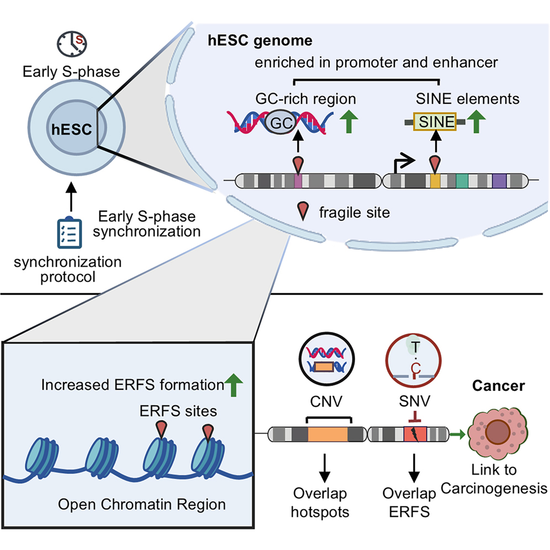
Figure:Long-term hESC culture causes chromosomal abnormalities, limiting clinical use. We mapped early replication fragile sites (ERFSs) in hESCs, which are enriched in GC content, SINE elements, and regulatory regions of pluripotency and genomic stability genes. ERFSs are associated with cancer-associated CNVs/SNVs and may be driven by chromatin accessibility, providing a key resource for understanding genomic instability.
Contact:
DONG YuPing, WANG Lin
Kunming Institute of Zoology, Chinese Academy of Sciences,
Kunming, Yunnan 650201, China
E-mail: wanglin2015@mail.kiz.ac.cn